

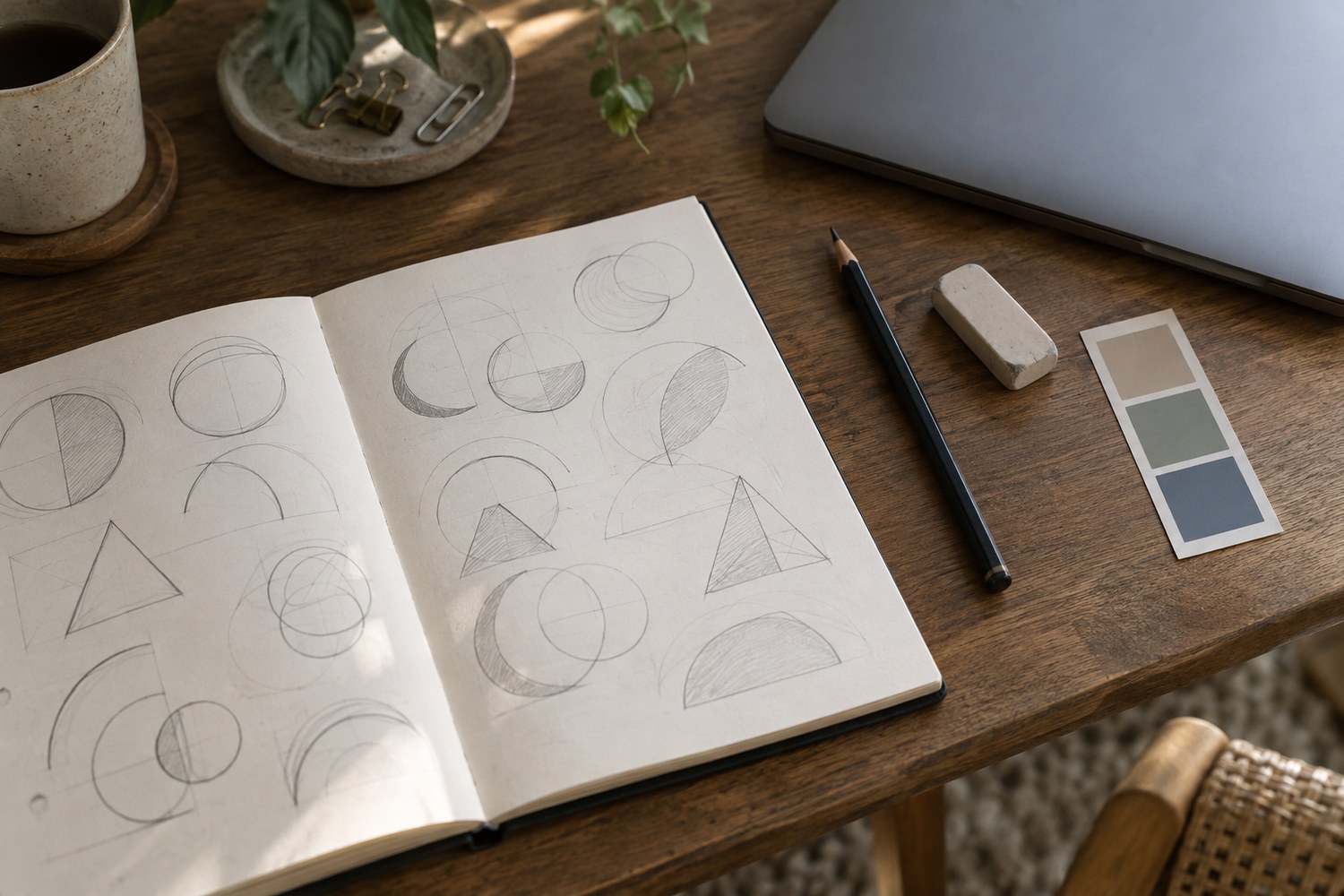
A logo is a graphic mark that represents a company's name or symbol; it is often the first thing a customer recognises the company by. Logo design does not start with drawing: first it becomes clear who the company speaks to and why, then come sketches, vector drawing, testing and handover. That order makes a logo not only attractive but workable in everyday use.
How a logo is made: the brief, competitor research, sketches, vector drawing, testing at small sizes and the files to hand over — step by step.
Where should logo design start?
With a brief. The brief sets down in writing what the company does, whom it serves, how it differs from competitors and where the logo will be used: website, social media avatar, business card, signage, packaging. That list changes later decisions — a sign that has to be read from a distance and a logo that only appears on screens have different requirements.
Research and sketches
Before sketching, the logos of other companies in the field are reviewed — to avoid looking similar and to understand the visual language of the sector. Then several different directions are worked up in simple form: a wordmark made of the name only, a symbol, or a combination of both. Colour does not matter yet at this stage — the shape should be recognisable in black and white.
Vector drawing, colour and type
The chosen direction is drawn in vector format: a vector logo scales from browser-icon size to signage size without losing quality. The colour palette and typeface are chosen here, and colour codes for screen and print are recorded separately. The logo is tested at small sizes, on dark and light backgrounds and in a single colour — a version that fails these tests causes problems every time it is used.
Which files should be handed over?
At minimum a vector file (SVG, PDF or EPS), a PNG with a transparent background, versions for light and dark backgrounds, horizontal and vertical versions where needed, and a list of colour codes. How the logo is to be used — minimum size, clear space, changes that are not allowed — is written down in the brand book. A company that receives a single JPG file has to have the logo redrawn at its first print order.
How to protect a logo
A logo can be registered as a trademark — legal protection that stops others from using a similar mark in the same field. Before registration, a search for similar marks is carried out; doing this at the design stage costs less than changing a finished logo later. We explain how the logo fits into a wider system in the article on branding.
When ordering a logo, look not only at the sketches but also at the brief, the tests and the files to be handed over — they are what decide how the logo works in everyday use.
Source: WIPO — Trademarks
Other articles:
we answer it.